Language: EN | RU
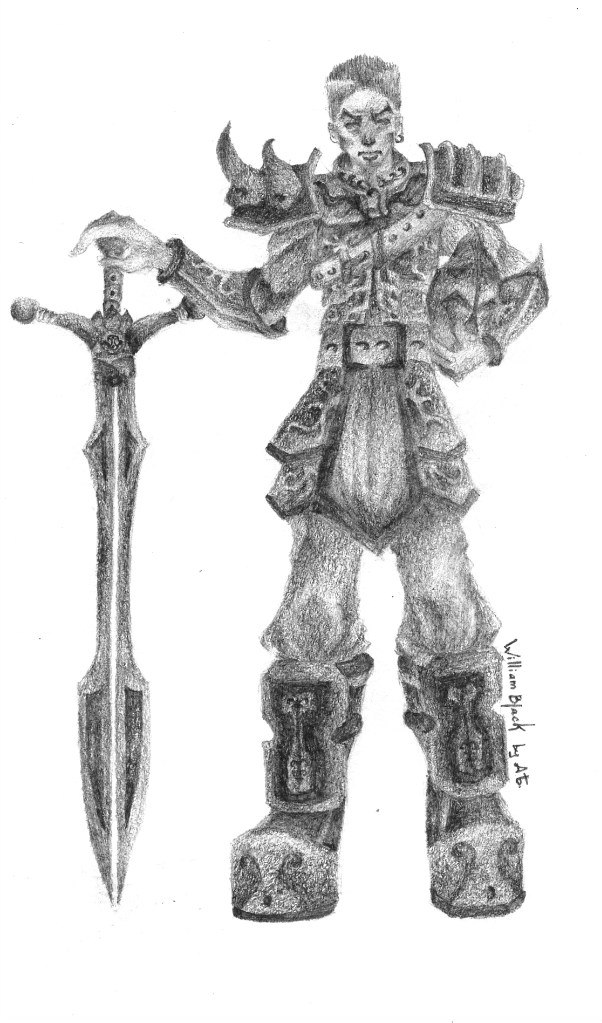
William Black
William Black is a legendary Hero in the Fable series who, at the dawn of Albion, defeated the sinister Jack of Blades, Knight of Blades, and Queen of Blades, collectively known as the Court.
After peace was restored, he united the land, founded the Old Kingdom, and established the heroic dynasty of Archons. The protagonists of all three games in the original trilogy belong to this bloodline.
William later outlived many of his famous descendants and eventually became known to players as Scythe. His story differs between the old and new Fable canon, although much of it remains unchanged in the Fable remake (2027).
History of William Black
Birth of a Hero
William Black was first mentioned in 2008 in Tales of Albion. According to legend, when Albion was still a young land, three cruel beings emerged from a mysterious realm known as the Void, determined to subjugate humanity. The Queen, the Knight, and Jack forced the people to bow before them and enslaved the peaceful lands.
Their rule lasted for generations and brought nothing but suffering. Eventually, a boy named William was born into the family of a humble blacksmith. He was destined to become the key to freeing Albion from the Court.
Growing Up
Nothing is known about William Black's youth. His extraordinary abilities became apparent once he reached adulthood. Through sheer force of thought, he could protect his village and perform feats unlike anything seen before.
This magical power became known as Will and would later become one of the three Hero disciplines. At the same time, William grew up dreaming of overthrowing the Court, convinced that he would eventually find a way to defeat them.
Encounter with the Court
His chance came unexpectedly. One night, while reading a mysterious book, William was suddenly transported into the Void and brought before the Court. Jack of Blades sat upon a throne surrounded by horrific figures and attempted to enslave William using the power of an "ornate sword."
But William resisted. Not only did he fight back, he stole the sword and escaped. After returning to the physical world, the weapon began speaking to him. The blade called itself the Sword of Aeons and promised to help him defeat the Court in exchange for his soul.
Fall of the Court
William evidently accepted the bargain. Armed with the Sword of Aeons, he set out in search of the Court, climbed Albion's highest mountain, Mount Ruon, and challenged his enemies to battle.
The Knight of Blades appeared first and was soon destroyed. William then faced Jack of Blades in a furious battle and shattered his body. But his fight against the Queen of Blades lasted for weeks and raged across Albion itself. Their blows were so powerful that new mountains rose and valleys were carved into the land.
At last, William slew the Queen and freed the people from slavery. They proclaimed him king, and the Hero took the title of Archon.
Rise and Fall of the Old Kingdom
After defeating the Court, the first Archon set out to unite Albion. Through the power of Will, he could literally reshape the world according to his wishes. New cities rose within weeks, while machines powered by magical energy appeared throughout the kingdom. During a thousand years of peace, Albion became a great centre of trade and philosophy.
But peace had its downside. With no common enemy left to fight, William's children grew cruel themselves. They called themselves Heroes and used their powers of Will to terrorise ordinary people.
William was unable to stop them because of his age and a severe illness that had begun wasting away his body and mind after his time in the Void. He put on golden chainmail and a royal blue cloak and disappeared. The kingdom descended into chaos and eventually collapsed under the rule of the first Archon's descendants.
Fighting the Darkness Within
After abandoning the kingdom he had built, William returned to the Void to purge the wasting illness from himself. In Fable: The Journey, Theresa explains that he succeeded, but the dark part of him remained trapped in the Void. It eventually became the Corruptor, which invaded Albion centuries later.
Gabriel: What's it all for? What does the Corrupter want?
Theresa: To reclaim something he believes was taken from him long-ago, at the height of the Old Kingdom. The Corruptor was once a man, or rather, part of a man. His name was William Black, the first and perhaps the greatest Hero Albion has ever known.
Gabriel: But how could it... he... be a Hero?
Theresa: Long ago, William saved Albion from enslavement and was crowned its ruler. But his victory came at a great cost, for he suffered a terrible wound to his soul. As Albion prospered, William slowly wasted away, his spirit twisted by a festering darkness. Realising what would become of Albion if he let himself be consumed, he gave up the crown and travelled to the Void. There he cut the corruption from within him, sealing it away forever. Or so he had hoped - for the evil he cleaved from himself lived on. Angry and powerful , it is bent on one goal: to return to our world and reclaim the throne denied him by William's sacrifice.
Gabriel: And Black? What happened to him?
Theresa: He was never seen again, at least not in any form that those who knew him would recognised.
A New Identity
After overcoming the mysterious illness, William Black returned to Albion as a Hero known as Scythe. The developers have confirmed that the two are the same person: first on the Lionhead Studios forums, and later through Dene Carter on social media.
According to Tales of Albion, Scythe appeared seemingly out of nowhere around the time the bandit Nostro arrived in Albion. By then, William was already incredibly old and resembled a wraith. He carried an "ornate sword" and wore the same golden armour and tattered blue cloak.
Sensing in Nostro the power shared by the descendants of the Archons, Scythe began teaching the mercenary the ways of Will, hoping he could unite the people once again. Under Scythe's guidance, Nostro founded the Heroes' Guild and the Witchwood Arena. Peace did return to Albion for a time, but Nostro eventually fell under the influence of the power-hungry courtesan Magdalena, and power corrupted him completely.
Watching Nostro and the Guild fall into decline, Scythe became disillusioned and disappeared. In his old age, the former bandit was left completely alone and was poisoned by an assassin. Before his death, Nostro recognised his mistakes and called for Scythe, who spent his final hours at his side before disappearing once again — until the first Fable game. More about this can be found in the separate Scythe article.
In that game, the Snowspire Oracle mentions that "the first Archon still casts his shadow in the world." Some players believe this was intended as a hint about William Black's fate. At the same time, however, the Oracle admits that it knows almost nothing about Scythe's origins.
Mentions and References
Under the name Scythe, William Black is mentioned several times throughout later games in the series. Some of the most interesting references can be found in Fable 2.
The game states that many people believed Scythe to be a necromancer, although he had long since disappeared from Albion. Meanwhile, the author of the book "Living Forever: The Immortalists" presents a theory that the Archons were immortal and that Scythe was one of them.
But the most important hint appears if the player chooses "Love" at the end of the game in order to resurrect the Hero's sister, Rose. Instead of returning, she sends the Hero of Bowerstone a letter explaining that she has found herself in a strange forest. Someone like a "king" is nearby — a scary, thin, hooded man who knows their family, yet somehow makes Rose feel safe.
In addition, Fable 3 features the "Scythe" tattoo set and Scythe's Warhammer. Its description reads: "It is foretold that one day Scythe will return to Albion. When he does, he might want his hammer back. Just a heads-up."
In the New Canon
In the Fable remake by Playground Games, some details of the game's universe have been changed. Even before release, the developers revealed that in their version of the story, William Black did not face the Court alone, but fought alongside two acolyte Heroes.
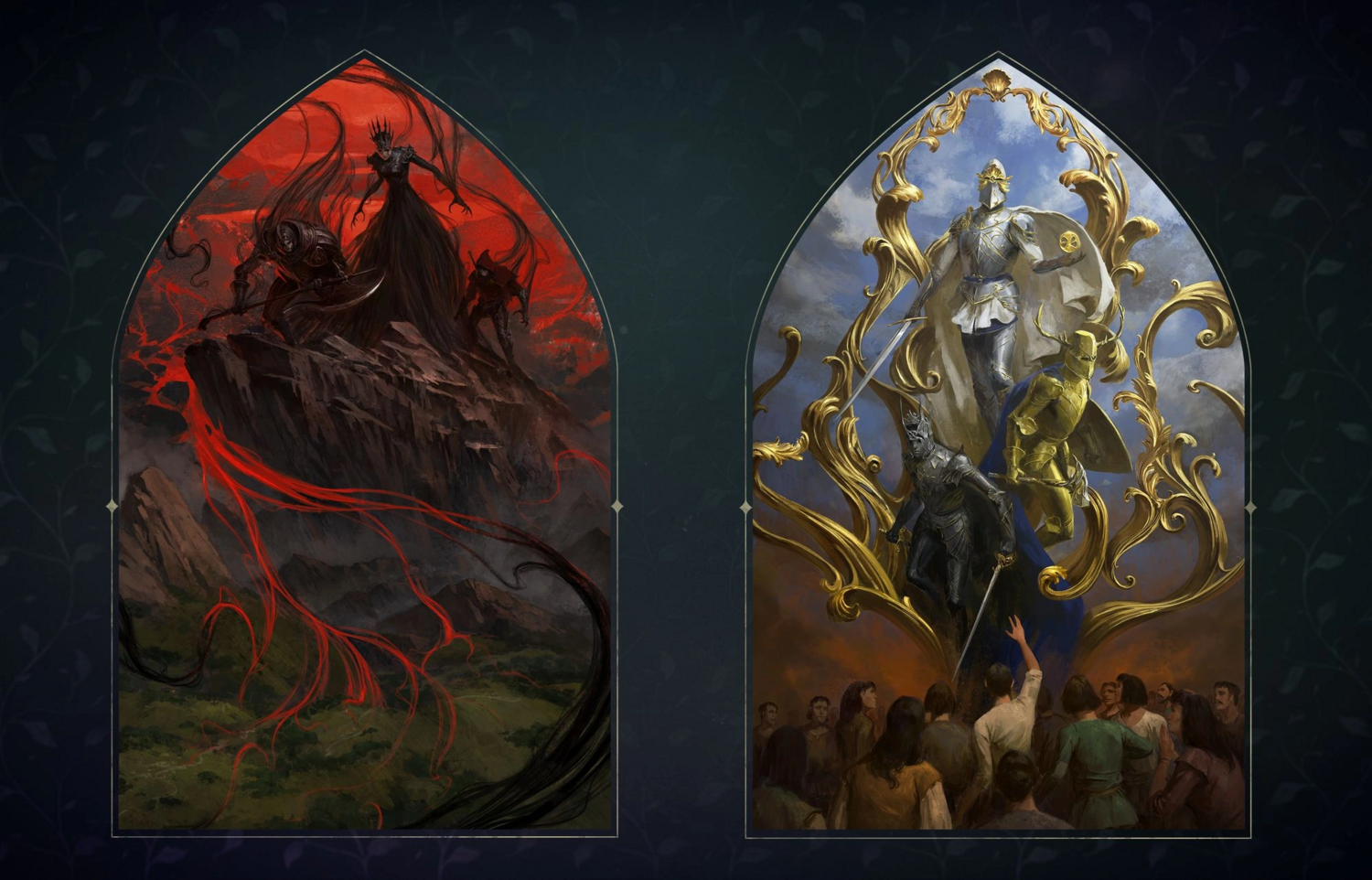
The developers also released illustrations of these events — the first-ever depictions of William Black in the history of the franchise.
Here, William appears as a knight clad in shining light-coloured armour with golden details, wearing a helmet, carrying a sword, and bearing the Guild emblem. He wears a white cloak, although parts of his clothing still retain the traditional blue colour associated with him.
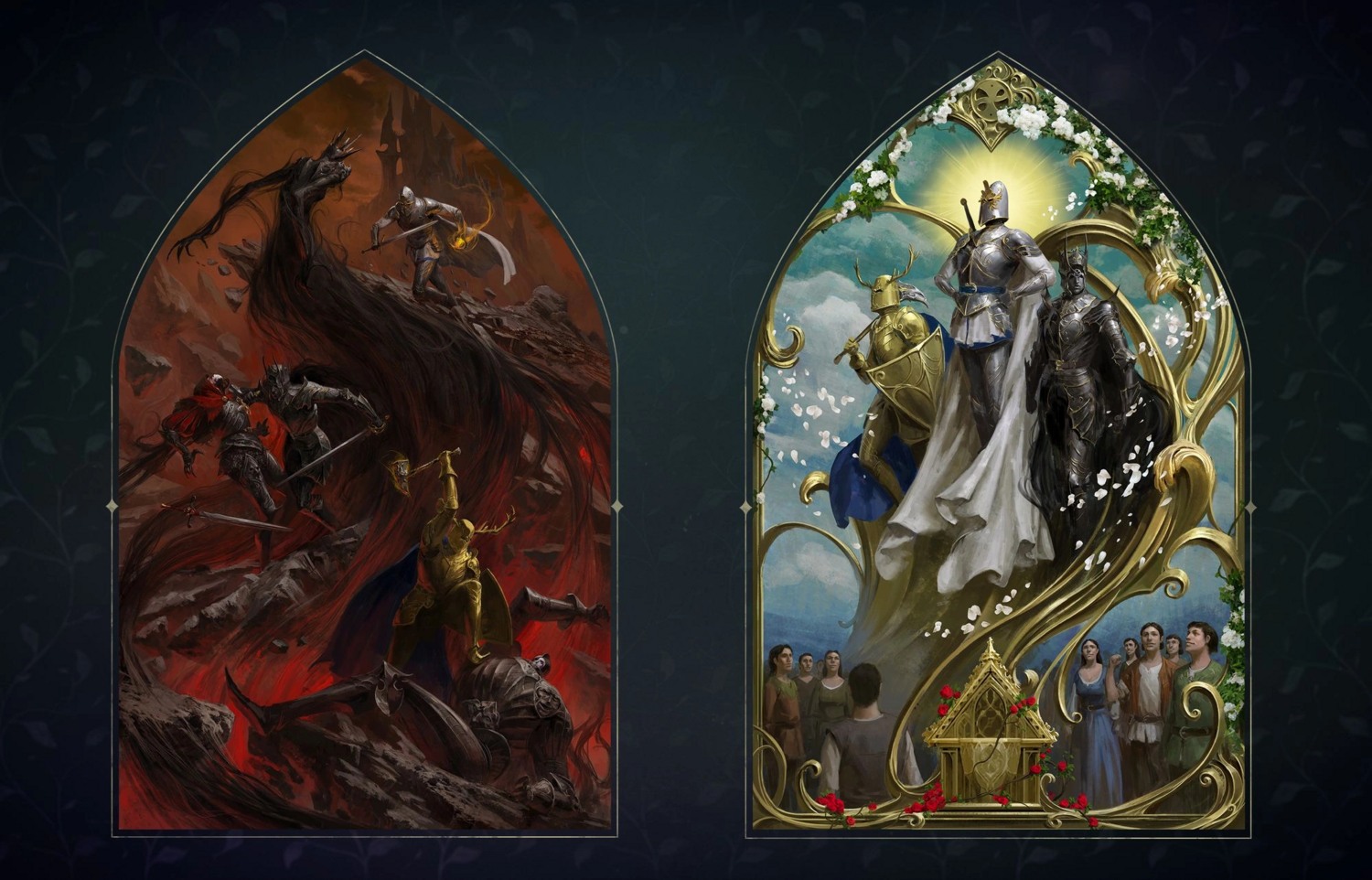
During the decisive battle, William faces only the Queen of Blades, while his companions deal with Jack of Blades and the Knight of Blades. Unlike in the original trilogy, these events are depicted on murals inside the Heroes' Guild.
Related Articles
- The story of Scythe
- The history of the Old Kingdom
- The Void
- The Corruptor
- The book "The Old Kingdom" from the first Fable
- The book "Living Forever: The Immortalists" from Fable 2