Language: EN | RU
Albion
Albion is a fictional country and a continent of the same name where all games in the Fable series take place. Its name echoes the ancient name for Britain, but this is probably just another joke by the developers: the fantasy Albion is very different from the real one.
- Geography of Albion in the original games
- -- Differences between maps
- -- Location of the continent
- -- Internal geography
- Geography of Albion in the new Fable
- Politics and laws of Albion
- Economy of Albion
- Religion of Albion
- Culture of Albion
- History of Albion in the old canon (page 2)
- -- Rule of the Court (page 2)
- -- Birth of William Black (page 2)
- -- Defeat of the Court (page 2)
- -- Rise of the Old Kingdom (page 2)
- -- Fall of the Old Kingdom (page 2)
- -- Dark Times (page 2)
- -- Rise of Nostro and a new Albion (page 2)
- -- Nostro's downfall (page 2)
- -- Albion after Nostro (page 2)
- -- Return of Jack of Blades (page 2)
- -- Rebellion in the Guild (page 2)
- -- Hero of Oakvale (page 2)
- -- Destruction of the Guild and the cults (page 2)
- -- Disappearance of Oakvale (page 2)
- -- Events in Southcliff (page 2)
- -- Role of the Hero of Bowerstone (page 2)
- -- Industrial Revolution (page 2)
- -- Overthrow of Logan and the battle with the Darkness (page 2)
- -- Uncertain future of the kingdom (page 2)
- History of Albion in the new canon (page 2)
- More on this topic (page 2)
Geography of Albion in the original games
Differences between maps
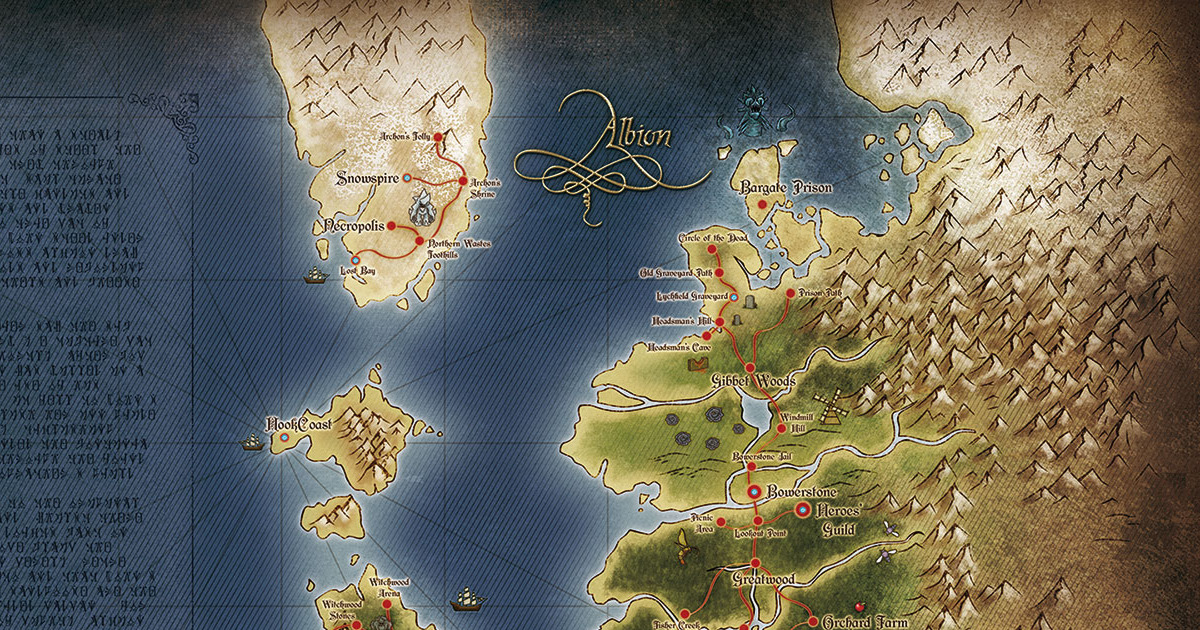
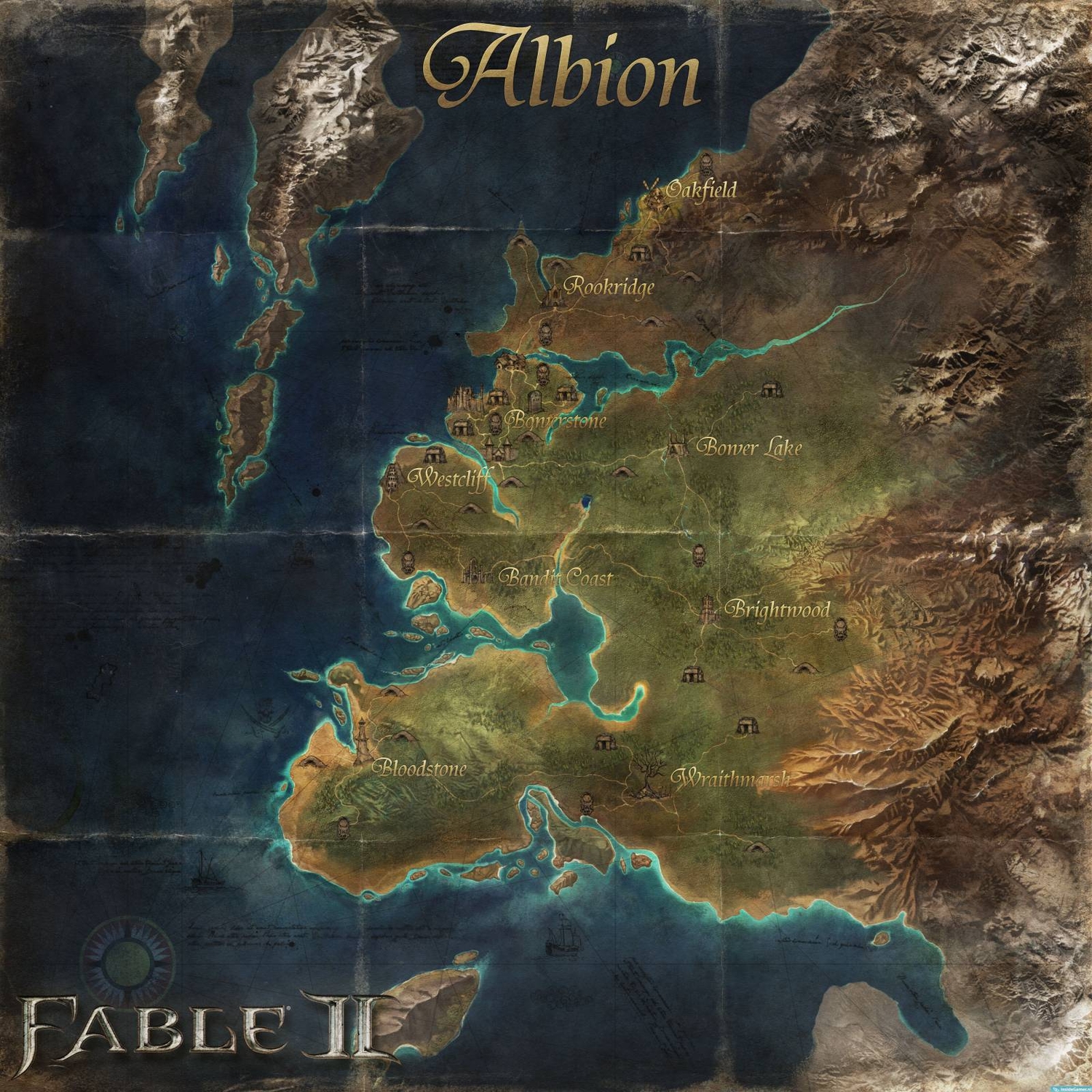
The boundaries of Albion as a continent and as a country are different, and can only be discussed approximately: in each Fable game, players see different versions of the maps and can visit only some of the regions. The actual number and size of the locations have always remained a mystery — which only worked in the story's favour.
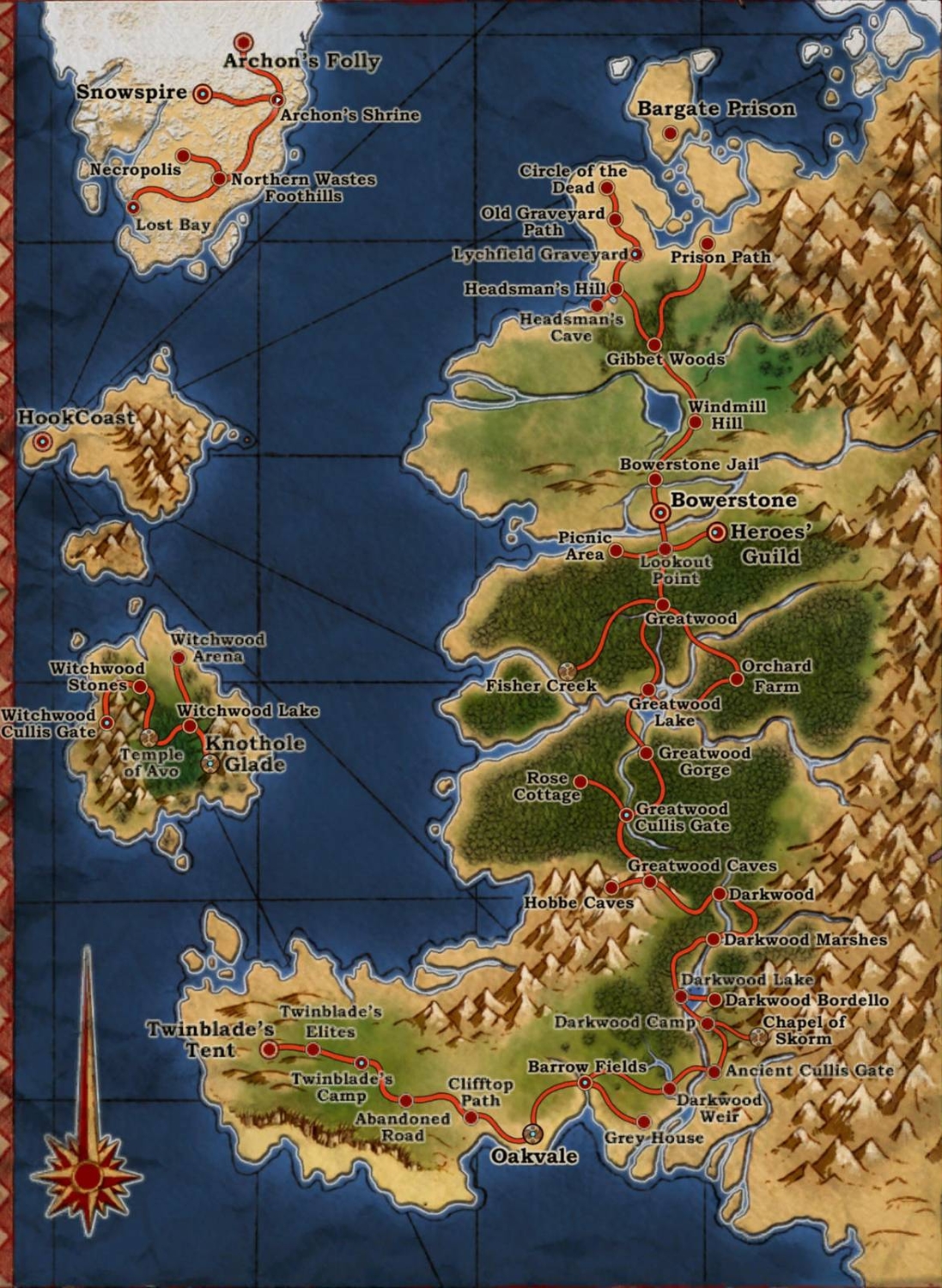
As early as Fable 2, the developers explained these discrepancies in the book "Introduction to Navigation": it says that old maps contained serious errors and that many settlements are actually located elsewhere. The inhabitants themselves sometimes say: "They say the world is much bigger now than it was 500 years ago". The map in Fable 3 added even more confusion, as it appears to be cropped and rotated by 90 degrees.
Some fans tried to solve the puzzle by creating their own diagrams showing the locations of places across different games in the series. To some extent, they succeeded: despite the puzzle surrounding Albion's maps, there are certain patterns in its geography.
Location of the continent
The continent of Albion is an immense expanse of green land filled with cliffs and caves. It is surrounded on all sides by an endless ocean. To the west lie the Northern Wastes, Hook Coast, Witchwood and Clockwork Island.
To the south lies the desert continent of Aurora. Between the shores of the two continents are several small islands, including Lion's Head Isle, Knothole Island, and the islands of Ravenscar Keep and the Godwin Estate.
It is also known that somewhere to the east of Albion lie Samarkand — the setting of the book "Fable: Edge of the World" — and the Eastern Kingdom (possibly the same place).
Internal geography
In the first Fable, it appears that the Hero of Oakvale reaches the northernmost point of the continent, where Headman's Hill, Lychfield Graveyard and Bargate Prison are located. It is unclear how accurate this part of the map is.
Fable: The Journey shows that the kingdom's northern frontier extends as far as Shalefields, the Whitespire Mountains and Echo Hills. Beyond the Ironwash River begin the undeveloped and highly fertile Edgelands, which are not part of Albion as a state.
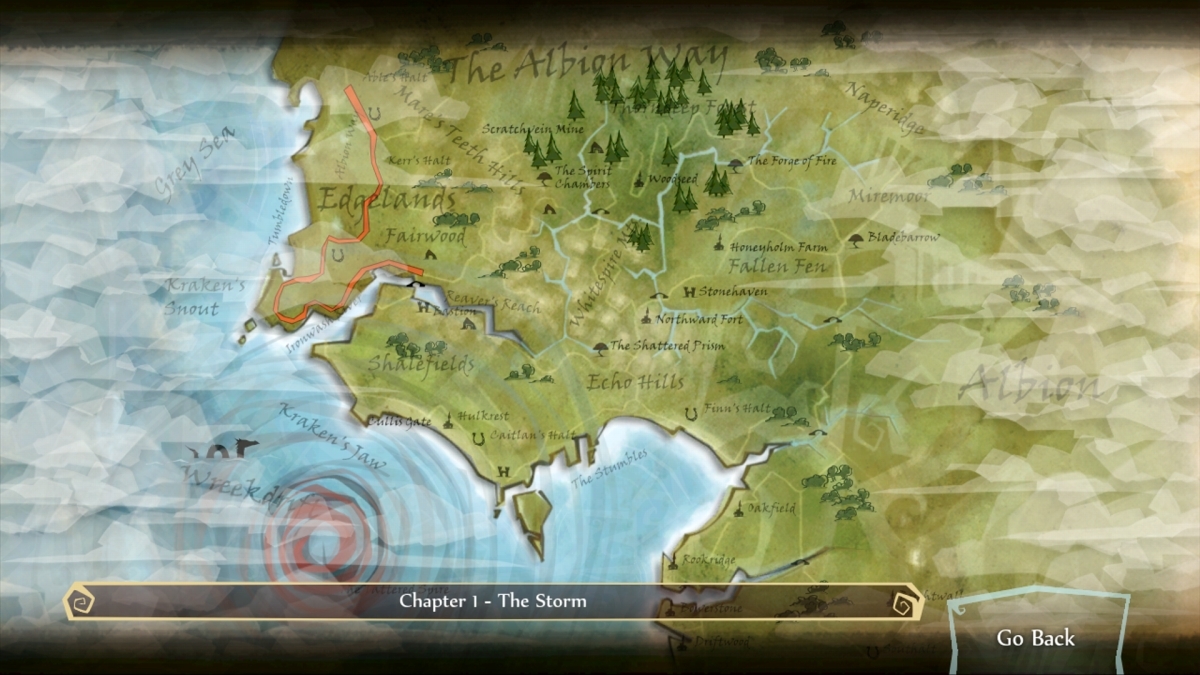
At the same time, the northernmost points on the Fable 2 map — Oakfield and Rookridge — lie south of the locations featured in The Journey. The monks' settlement from the second game, for example, sits modestly at the very bottom of its map.
In the western part of the continent's central region, on the ocean coast, lies its largest city, Bowerstone, together with its surrounding urban area. It has always been considered the de facto capital of the country and officially secured this status with the beginning of the reign of the Hero of Bowerstone. Nearby are Lookout Point and the Heroes' Guild — or Bower Lake / Millfields in Fable 2 and Fable 3 — as well as the marshy Mourningwood.
The continent ends in the east at the Mistpeak mountains, while farther south travellers face vast and dangerous forests: Greatwood, followed by Darkwood, Brightwood and Deepwood, which never made it into the game.
The south of Albion differs between the games just as much as the north: in the first Fable, it is a pleasant, sunny coastal region, while in the second game and beyond it becomes an impenetrable, deadly and almost uninhabited swamp.
In TLC and Anniversary, the southern region includes Barrow Fields, Oakvale and Twinblade's Camp. Centuries later, players find Wraithmarsh and Bloodstone in their place. Reaching the pirate town overland is virtually impossible for an ordinary resident of Albion.
There are also locations mentioned only in canonical sources but unavailable to visit, including the legendary Mount Ruon, Southcliff, the village of Gunk, where Ben grew up, and the town of Gralock from the book "Fable: Blood of Heroes".
Almost nothing is known about the numerous cities of the Old Kingdom, whose ruins can be found throughout Albion. The cancelled Fable Legends also featured many locations and regions: 400 years before the first Fable, places such as the town of Brightlodge, Rosewood and dozens of other named locations existed.
Geography of Albion in the new Fable
In Fable (2027) from Playground Games, Albion has undergone major changes. It is divided into six regions, including Deepwood and Oakshire.
Oakshire was created by a Hero who destroyed part of Deepwood. The region is home to the village of Silverbrook, whose residents are obsessed with all things vegetable-related. The village of Arrowmark is also known to exist.
Among the familiar locations returning in the game are Bowerstone, Bloodstone, Wraithmarsh and Windmill Hill.
However, in the reboot Bloodstone is now located in the north, on Bloodland Bay, while Bowerstone lies in the south, on the banks of the River Bower. In this "new take on the franchise", they became twin cities founded by companions of William Black.
Politics and laws of Albion
According to in-game sources, Albion was a prosperous and wealthy country during the age of the Old Kingdom. When the rule of the Archons fell, its people were left without any unified political system.
This state of affairs continued into the time of the first Fable, when Albion effectively consisted of independent city-states. The most influential and wealthy of them was Bowerstone, ruled by the Grey dynasty.
Despite the absence of unified laws and regulations, the civilised settlements developed similar rules of reasonable behaviour, enforced by guards. Violence, vandalism and theft could result in fines or expulsion, while Bowerstone also prohibited carrying any weapons.
In Fable 2, the main economic centres changed, but the political situation itself did not. Most of the population lived in Bowerstone, Oakfield, Southcliff, Westcliff and Bloodstone. The largest city, Bowerstone, was now ruled by the Fairfax family, who owned an enormous castle. As the fame, wealth and achievements of the Hero of Bowerstone grew, the Hero succeeded the deceased Lucien Fairfax and restored royal rule to the country.
Fifty years later, in Fable 3, Albion is already a large state with strong centralised rule, a regular army, advanced technology and a population of at least 6.5 million people. Guards have been replaced by soldiers in the cities, although remote regions remain largely uncontrolled. According to "Fable: Edge of the World", Aurora becomes part of the kingdom during the reign of the Hero of Brightwall.
Economy of Albion
As with politics, Albion had no unified economy from the fall of the Old Kingdom until Fable 3.
In the first and second games, there is a common currency — the gold coin — but trade between cities develops chaotically and relies heavily on travelling merchants. As a result, the prices of goods vary greatly depending on where they are bought or sold and may bear little relation to their actual value. There is no industry yet, and the main sectors are services, agriculture and craftwork.
During Fable 2, steam technology gradually begins to appear in Albion, and by Fable 3 the country is undergoing a true Industrial Revolution, reminiscent of the real scientific and technological transformations of the 19th century.
As a result, huge factories with smoking chimneys appear in Bowerstone Industrial and other settlements, while even remote parts of the country are connected by a monorail railway. Judging by the locations seen in Fable: The Journey, large-scale industrialisation continued in later years.
Religion of Albion
In the first Fable, the people of Albion worship the benevolent god Avo and the evil Skorm. Although the Snowspire Oracle reveals that both are fictional deities, each has a temple in Witchwood and Darkwood respectively.
The shrines were built in places where magic is particularly strong, which explains how both cults arose. At the Temple of Avo, the Hero can donate gold and become younger, while at the Chapel of Skorm in Darkwood, people can be sacrificed in exchange for a legendary bow.
For a time, faith in Avo and Skorm was strong enough to cause a war between the two churches. The descriptions of the "Holy Warrior Helm" and "Demonic Warrior Helm", which can be found in the Northern Wastes, state that this happened 200 years before the events of Fable 1.
Soon after the events of the first game, the people of Albion stopped worshipping Avo and Skorm and destroyed their temples during the Decade of Knowledgification. Before long, they began worshipping the Light and the Shadows instead and built two new shrines: the Temple of Light in Oakfield and the Temple of Shadows in Rookridge. The former was founded by Albert the Luminous and gave rise to a new faith. The Temple of Shadows, meanwhile, was destroyed a couple of decades later during a dark ritual and was only restored several centuries later by Cornelius Grim.
In Fable 2, the mechanics of sacrifices and rewards in both temples are broadly similar to those in the first Fable. Religion is barely addressed in Fable 3, although the Hero can help a man named Lesley restore an ancient Dark Sanctum in Mourningwood. If this is done, human sacrifices will once again be performed in the new temple.
Culture of Albion
The people of Albion belong to a variety of cultures that reflect the different economies of individual towns and the social status of their inhabitants. The country includes both developed settlements such as Bowerstone and Brightwall, and lawless communities such as Twinblade's Camp, which later became Bloodstone, the Dweller Camp and Driftwood.
This has also shaped Albion's social classes: the poor of the urban slums, wealthy mansion owners, inhabitants of numerous villages, guards (later soldiers of the Royal Army), and bandits or mercenaries.
Books, theatre and music remain consistently popular forms of entertainment in Albion, as do visits to pubs for drinking, gambling and listening to bards, or trips to brothels. The people of Albion also enjoy public spectacles: in Fable 1 these include nighttime fist fights, the Arena, an archery contest in Witchwood, Chicken Kicking in Oakvale and a fishing competition in Greatwood.
In the second game, the Arena was replaced by the Westcliff Crucible, with the Westcliff Shooting Range nearby. Fable 3 features chicken races in Brightwall, a shooting range in the Mercenary Camp and Reaver's Wheel of Misfortune. Travelling lute players can often be encountered on the streets.
Albion's best-known literary works are the plays of Philipth Morley, which have repeatedly been staged in theatres. There are other well-known authors as well, such as Meredith Sock.
The people of Albion also have some access to education: various books, including scientific treatises, can be purchased throughout the series, while the first and third games feature schools for children. The academic community is represented at least by the Bowerstone Maritime Academy in Fable 2 and Brightwall Academy in Fable 3. The latter was founded by the Hero of Bowerstone specifically to make knowledge more accessible.
1 2